VIA MOLDAVIA arrives in Suceava | The fifth working meeting of the program, at the Seat Fortress of Stephen the Great
Mesaje publice
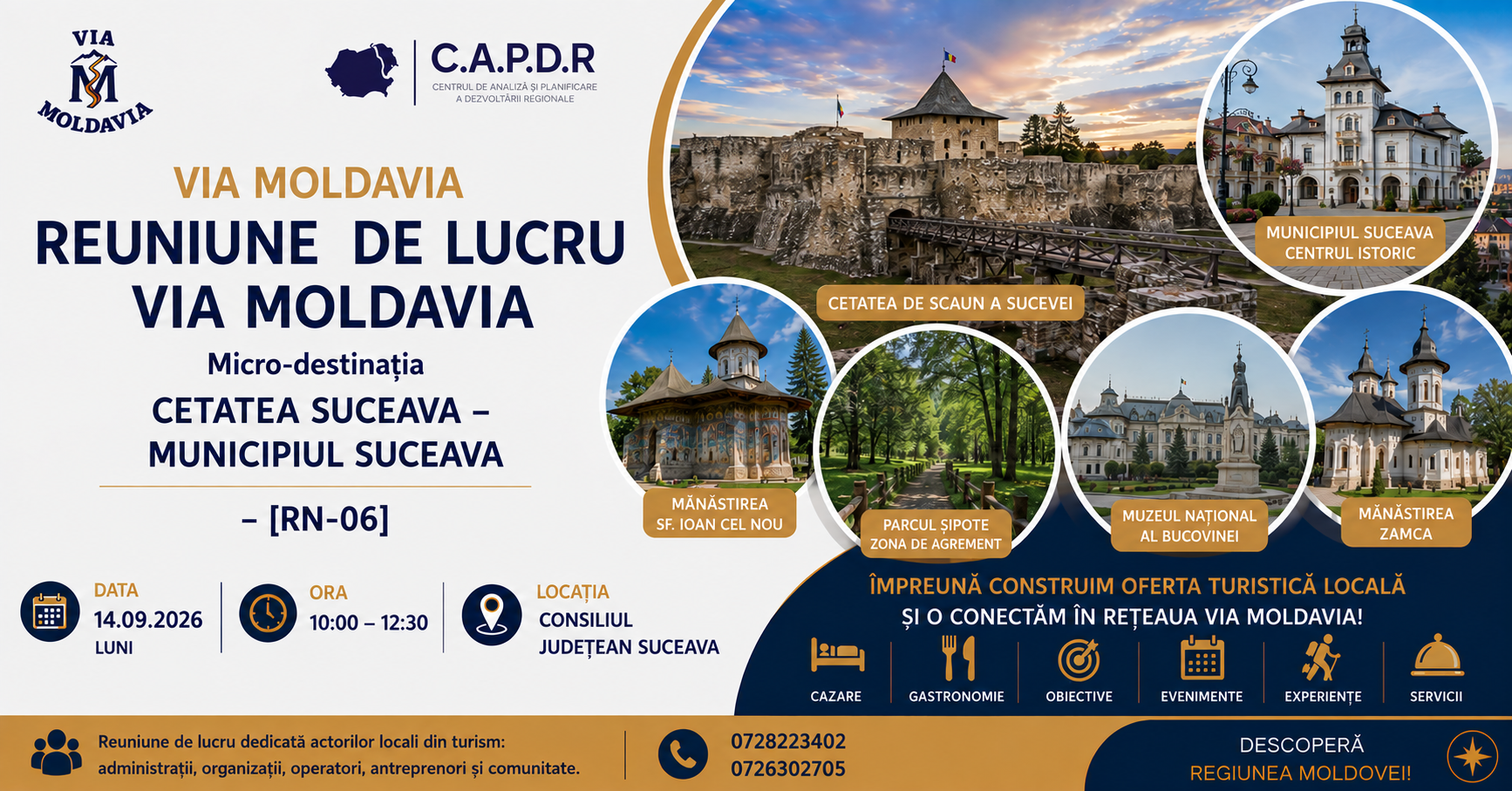
Monday, September 14, 2026, on the Feast of the Exaltation of the Holy Cross, the VIA MOLDAVIA program arrives in Suceava, for the fifth working meeting in the series of territorial consultations dedicated to building a new regional tourism architecture. The meeting will take place at 10:00 AM, at the Suceava County Council.

After Târgu Neamț, Bicaz, Slănic Moldova and Ariniș – Gura Humorului, VIA MOLDAVIA arrives in one of the most important municipalities of the Moldavian region, in a space where history, faith, administration and regional development come together in a distinctive way.
Suceava is one of the major historical landmarks of Moldova, as well as a strong administrative, economic, university and tourism center of the present day.
Here, in the symbolic space of the Seat Fortress of Stephen the Great, historical memory can become the starting point for a contemporary construction: a better-connected, more coherent and stronger tourism region in relation to national and international markets.
A program built from the territory
The VIA MOLDAVIA series of meetings started from a simple idea: a strong regional destination is built in the territory, together with the people, public administrations, entrepreneurs and organizations that know its resources and potential.
VIA MOLDAVIA continues across the territory: a calendar dedicated to building the micro-destinations of the Northern Route
The official program calendar establishes a sequence of meetings that will make it possible to approach the territory as a network, rather than as a collection of independent destinations.
VIA MOLDAVIA Meeting Calendar – Northern Route:

The first meeting in this series took place in Târgu Neamț, on September 1, 2026, and was dedicated to the micro-destination RN-02 – Târgu Neamț – Neamț Fortress, the monasteries and the Bison Land. The meeting focused on identifying tourism resources and building an experience that connects heritage, spirituality, nature and local hospitality.
On September 3, 2026, the process continued in Bicaz, for micro-destination RN-01, with a focus on nature, landscape, leisure and local experiences. The area under analysis brings together Bicaz, Bicazu-Ardelean, Bicaz-Chei, Tarcău, Ceahlău, Hangu, Grințieș and Durău. The meeting emphasized the need to connect resources and transform them into tourism experiences and products.
On September 8, 2026, at the Panoramic Slănic Moldova Complex, CAPDR organized a new VIA MOLDAVIA working meeting dedicated to the Trotuș Valley Micro-Destination – spa tourism, nature, heritage and leisure, as part of the process of identifying, connecting and capitalizing on local tourism resources through integrated products and experiences.
Through these four meetings, VIA MOLDAVIA is beginning to take shape as a genuine network of tourism micro-destinations, each with its own identity, yet connected through a common regional strategy.
Suceava – the fifth meeting and a strategic landmark
On September 14, this construction reaches Suceava.
The moment carries a special significance.
The date coincides with the Feast of the Exaltation of the Holy Cross, one of the great feasts of Christianity, while the connection with Suceava and the memory of Stephen the Great gives this VIA MOLDAVIA stage a dimension that goes beyond the framework of a technical meeting.
Faith, history and Moldova’s heritage become part of a reflection on what the region can build for the future.
Suceava has all the prerequisites to become one of VIA MOLDAVIA’s main anchor points.
The municipality brings together institutions, infrastructure, the economy, the university environment, tourism services and access to some of Bucovina’s most important destinations.
The Seat Fortress, urban heritage, the monasteries of Bucovina, the mountain area, gastronomy, traditions, active tourism and HoReCa services can be connected into a broader regional offer, built around a strong identity.
In this context, CAPDR President Ion ȘTEFANOVICI emphasizes the strategic dimension of the program:
“History gives a region the legitimacy of memory; the future, however, requires it to have the capacity to transform this memory into a project. VIA MOLDAVIA does exactly that: it brings together places, communities and interests in a regional construction that starts from Moldova’s identity and opens towards Europe and the world. Suceava, the Seat Fortress of Stephen the Great, is one of the places where the past and the future can meet with dignity.”
The next VIA MOLDAVIA stages
The Suceava meeting represents the fifth stage of a calendar that continues throughout September and October.
After Suceava, VIA MOLDAVIA continues with:
On September 18, VIA MOLDAVIA will arrive at RN-12 – Bistrița Valley, with the meeting scheduled at the Farcașa Town Hall. The micro-destination will include, within its indicative area, the localities of Poiana Teiului, Farcașa, Borca and Broșteni, together with the surrounding territory.

On September 21, the series of meetings will continue with RN-13 – Talienilor Road, in a distinctive setting, at the Suceava Forestry Directorate Lodge. The indicative territorial area will include Mălini, Berchișești, Moara, Brăiești, Cornu Luncii, Slatina, Valea Moldovei and Găinești.

On September 25, the meetings will continue with RN-08 – TransRarău and the ski area, at the Council Chamber of the Vama Town Hall. Câmpulung Moldovenesc, Vama, Prisaca Dornei, Valea Bistriței, Stulpicani and Ostra will be part of the indicative territorial area analyzed within this micro-destination.

On September 28, VIA MOLDAVIA will dedicate a new meeting to RN-05 – Land of the Monasteries, to be held at the Sucevița Town Hall. The micro-destination will bring together Sucevița, Voroneț, Dragomirna, Putna and the surrounding monastic area, with an approach focused on integrating heritage into a regional tourism circuit.

On October 2, the series will continue with RN-04 – Dornelor Basin, with the meeting to be hosted by the Șaru Dornei Town Hall. The indicative area of this micro-destination includes Șaru Dornei, Dorna Arini, Panaci, Dorna Candrenilor, Vatra Dornei and Poiana Stampei.
On October 6, the program will have a stage dedicated to RN-14 – Chișinău, Republic of Moldova. The meeting is scheduled to take place at the Ministry of Economic Development and Digitalization in Chișinău and will have the Republic of Moldova as its indicative territorial area, strengthening the perspective of connecting the VIA MOLDAVIA network with the cross-border Romania–Republic of Moldova component.

On October 9, the calendar provides for the meeting dedicated to RN-10 – Cultural Botoșani – Memorial Houses and Cultural Heritage. The date has been established, while the location is to be confirmed. The micro-destination will have the municipality of Botoșani and the surrounding territory as its indicative area.
As the calendar continues, the meeting dedicated to RN-11 – Iași – business tourism, city breaks and religious tourism will have a date that is yet to be confirmed. The micro-destination will have the municipality of Iași and the surrounding territory as its indicative area.
Also scheduled for a date to be confirmed is the meeting for RN-15 – Red Lake, with the indicative territorial area of Red Lake / Harghita. This will complete the series of micro-destinations included in the VIA MOLDAVIA calendar.

Each of these meetings is intended to identify local resources, tourism services, attractions, infrastructure, projects and stakeholders who can contribute to building a common regional tourism offer.
From micro-destinations to the Palace of Parliament
All these stages converge towards one of the program’s most important objectives for 2026: the VIA MOLDAVIA International Tourism Fair, scheduled for October 26–28, 2026, at the Palace of Parliament in Bucharest.

October 27 will represent the core day of the event’s proceedings, presentations and professional meetings.
The event is designed as a major point of convergence for tourism destinations, public administrations, destination management organizations, HoReCa operators, entrepreneurs and program partners.
What is being built across the territory during September and October will then be brought together, presented and connected in Bucharest.
Târgu Neamț, Bicaz, Trotuș Valley, Ariniș – Gura Humorului, Suceava and the following micro-destinations represent parts of the same construction.
The fair at the Palace of Parliament will provide an opportunity to move from local and regional meetings towards an integrated presentation of the VIA MOLDAVIA program.
A regional destination built on local identities
VIA MOLDAVIA aims to develop a tourist-oriented platform and, behind it, to strengthen a network of collaboration among administrations, destinations, organizations, economic operators and communities.
Each micro-destination retains its specific character.
The strength of the project emerges through connecting these identities into a common regional framework.
From fortresses and monasteries to mountains, lakes, spa resorts, historic cities, gastronomy and rural communities, Moldova has a heritage rich enough to build a tourism offer of significant scale.
The objective of VIA MOLDAVIA is to transform this diversity into a coherent and accessible system for tourists.
“On September 14, on the Feast of the Exaltation of the Holy Cross, VIA MOLDAVIA leaves Ariniș – Gura Humorului and arrives at the Seat Fortress of Stephen the Great. At 10:00 AM, at the Suceava County Council, we continue a journey in which the faith, heritage and history of Moldova become the foundation for what we build next.”
After Târgu Neamț, Bicaz, Slănic Moldova and Ariniș – Gura Humorului, Suceava becomes the fifth landmark along this journey.