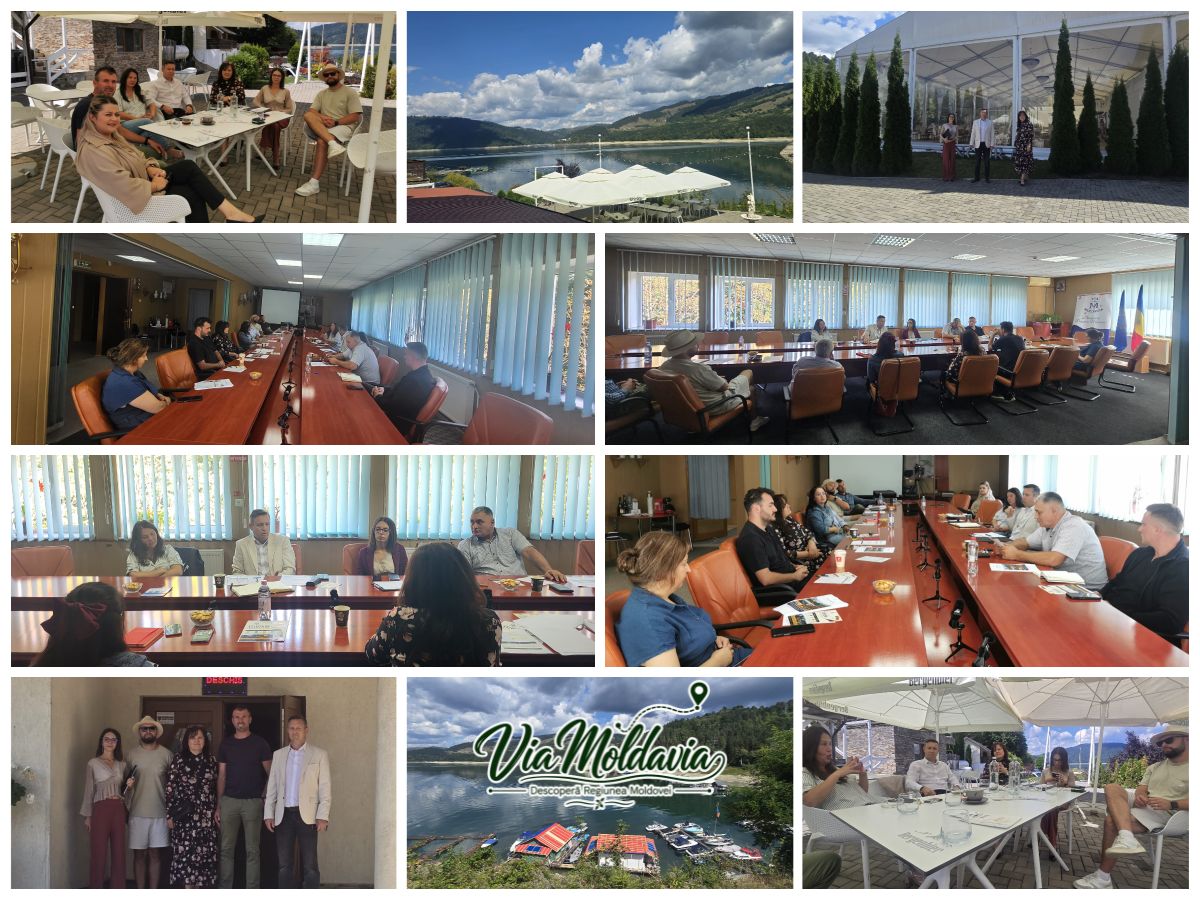
CAPDR organized the VIA MOLDAVIA Working Meeting dedicated to the Bicaz micro-destination – where nature becomes an experience
Mesaje publice
The Centre for Analysis and Regional Development Planning – CAPDR organized, on 3 September 2026, the second VIA MOLDAVIA Working Meeting within the Northern Route, dedicated to the “Bicaz” micro-destination

The meeting was part of the process of shaping and operationalizing the VIA MOLDAVIA tourism micro-destinations and focused on identifying, structuring and connecting the area’s tourism resources into a coherent and integrated offer.
The meeting dedicated to the Bicaz – RN-01 micro-destination continued the series of working meetings through which CAPDR is gradually building the VIA MOLDAVIA Northern Route, starting from the specific characteristics of each territory and from the tourism resources that can contribute to the development of routes, experiences and tourism products.
The indicative territorial area of the micro-destination includes Bicaz, Bicazu-Ardelean, Bicaz-Chei, Tarcău, Ceahlău, Hangu, Grințieș and Durău, bringing together a territory with significant potential for the development of nature-based tourism, landscape tourism, recreation and local experiences.

Representatives attending the event:
- ȘTEFANOVICI Ion, President, C.A.P.D.R.
- MATASA Iulian, Mayor, Bicaz City Hall
- FÎRȚALĂ Manole-Dănuț, Mayor, Tarcău City Hall
- ȘTEFAN Adrian, Councillor, Tarcău City Hall
- RUSU Gabriela, Administrator, Ancora by the Lake
- AMARIEI Mihai, Director, Adora Complex
- ROSU Marta, Representative, Vizit Bicaz
- TATARU Ioana, Manager, Motel Piatra Corbului
- ARDELEANU Ana-Maria, Administrator, Grădinile Romane Bicaz
- BALINT Daniel, Owner, Blue Paradise
- ROGIN Alexandru, Owner, Casa Rogin
- HÎNCU Nadia, Network Manager, C.A.P.D.R.
- CUCOȘ Andreea, Manager, C.A.P.D.R.
Bicaz – from tourist attractions to an integrated micro-destination
During the discussions, participants emphasized the need to promote the Bicaz area as an integrated micro-destination, where natural attractions, heritage, gastronomy, recreational activities and local events are connected into a coherent offer.
“Bicaz should not be merely a transit point towards other tourist attractions, but a territory where tourists can find enough reasons to stay, discover the area and return,” stated Iulian MATASA, Mayor of Bicaz
Bicaz Lake – developing water-based experiences
Participants highlighted the need to make more consistent use of Bicaz Lake through tourism and recreational activities. In this context, the existence of an authorized location for boat access to the lake was mentioned as an element that can be integrated into future tourism products of the micro-destination.
“The lake should become a tourism experience in its own right, not merely a landscape feature. Organized access and water-based activities can contribute to diversifying the offer and extending tourists’ stays,” stated Gabriela RUSU, Administrator of Ancora by the Lake

Tourist routes – connecting the territory
Another important topic of the meeting was the development and promotion of routes that can connect the localities and attractions within the micro-destination. The Queen Maria Route, a project of the County Council, the Monasteries Route, as well as connections to Toaca Peak, Red Lake and other mountain points of interest were mentioned.
“Routes must be viewed as tools for connecting the territory. It is not enough to have valuable attractions if tourists do not know how to discover them in a logical sequence,” stated Ion ȘTEFANOVICI, President of C.A.P.D.R.
The axial road to Durău – a strategic tourism axis
The meeting highlighted the role of the axial road to Durău in connecting the area’s tourism resources. It can facilitate access to several experiences and attractions, including Bistra Montana Trout Farm, mountain trails and connections towards the Red Lake area.
“Access infrastructure must be aligned with the tourism offer. A road can also become a tourism axis when it connects experiences, attractions and services that tourists can enjoy along the same route,” stated Ana Maria ARDELEANU, Administrator of Grădinile Romane Bicaz

Buhalnița – local gastronomy as a tourism experience
Local gastronomic points in Buhalnița were identified as resources that can contribute to developing an authentic tourism offer. Gastronomy can complement nature and recreational experiences and can represent an important element in differentiating the micro-destination.
“Tourists are not looking only for a place to visit, but also for a local experience. Gastronomy can be one of the most direct ways for them to connect with the community and the identity of the place,” said Ioana TATARU, Manager of Motel Piatra Corbului
Heritage and royal memory – Bicaz and Queen Maria
The discussions highlighted the fact that Bicaz City Hall operated as a former Royal House, creating an opportunity to capitalize on the town’s connection with Queen Maria. This component can be correlated with the development of the Queen Maria Route and transformed into a storytelling element of the micro-destination.
“Heritage should not be presented merely as historical information. It can become a story that connects places and gives tourists an additional reason to discover the territory,” emphasized Manole-Dănuț FÎRȚALĂ, Mayor of Tarcău

Local events – reasons to visit and return
Participants identified events such as the Tarcău Marathon, a national-level sporting event, and the Cauldron Festival as elements that can be integrated into the tourism calendar of the micro-destination.
“Events can bring tourists to the territory during a specific period and can become the starting point for discovering other attractions and experiences within the micro-destination,” emphasized Mihai AMARIEI, Director of Adora Complex
Active tourism and nature experiences
The area’s natural resources provide favorable conditions for developing active tourism through mountain trails, lake activities and nature experiences. Among others, Piatra Corbului, the Ceahlău area and trails leading to Toaca Peak were mentioned.
“Nature is one of the main resources of the micro-destination, but its tourism value increases when it is transformed into accessible, well-signposted experiences that are easy to book or explore,” reiterated Marta ROSU, Representative of Vizit Bicaz

Via Mioritica – connecting Bicaz to a national route
The opportunity to connect the area to Via Mioritica was also presented, a project associated with Daniel Balint – Grup Paradise, which crosses Romanian territory and includes the voluntary involvement of the Buhalnița community.
“Connecting to routes that extend beyond the boundaries of the micro-destination can bring Bicaz into a broader tourism circuit and facilitate access to new categories of tourists,” added Daniel BALINT, Owner of Blue Paradise
Educational tourism – children, foreign languages and Romania–Republic of Moldova exchanges
Participants identified the possibility of developing children’s camps with an English-language component, as well as projects through which children from Romania and the Republic of Moldova could interact and learn Romanian as part of educational partnerships.
“The micro-destination can also be a space for education and exchanges between generations. Camps and projects for children can create tourism experiences with a strong educational and intercultural dimension,” stated Alexandru ROGIN, Owner of Casa Rogin

Tourist information – from non-functional points to accessible information
The meeting highlighted the situation of non-functional tourist information points, as well as the need to develop an information point for the Valea Muntelui area. Participants emphasized the importance of tourists being able to quickly find out what they can visit, what activities they can undertake and what services are available.
“It is not enough for information to exist. It must be available to tourists precisely when they need it,” explained Adrian ȘTEFAN, Councillor, Tarcău City Hall
Signposting experiences – “What can I do here?”
An important proposal was the creation of signs and signposting elements indicating the activities and experiences available at each point within the micro-destination.
“Signposting must answer a simple question from the tourist: ‘What can I do here?’. The experience must be built around this question,” mentioned Iulian MATASA, Mayor of Bicaz

Digital promotion and the visibility of the micro-destination
Participants emphasized the need for more active promotion in the digital environment, including through platforms and networks used by tourists. Tripadvisor was mentioned, along with the need to promote local resources through social media, including the educational offer.
“A tourism resource that tourists cannot find online is, in practice, a resource that does not exist for an important part of the market,” stated Ana-Maria ARDELEANU, Administrator of Grădinile Romane, Bicaz
Destination management – building a common structure
The process of establishing a county-level Destination Management Organization was mentioned, with the structure to be established. Participants emphasized the importance of connecting local initiatives to the future county-level tourism management and promotion mechanism.
“The development of a destination cannot be carried out separately by each locality. A common structure and vision are needed to showcase the entire territory,” mentioned Gabriela RUSU, Administrator of Ancora by the Lake

Bicaz – a micro-destination built through collaboration
In conclusion, participants emphasized that the potential of the Bicaz – RN-01 micro-destination lies in the diversity of its resources and, above all, in the possibility of connecting them: lake, mountains, heritage, gastronomy, routes, events, education and local experiences.
“VIA MOLDAVIA must transform the resources we already have into an offer that tourists can understand, choose and purchase. Bicaz has the resources; the next step is to connect them and transform them into experiences,” added Ion STEFANOVICI, President of C.A.P.D.R.
Bicaz – a micro-destination built around nature and the tourism experience
Within VIA MOLDAVIA, the development of a micro-destination starts with identifying existing resources and determining how they can be connected into an accessible and attractive tourism experience.
For the Bicaz area, the proposed territory brings together localities and points of interest that can contribute to shaping an integrated tourism offer, with an emphasis on nature, landscape, recreation and experiences.
Bicaz and the localities within the micro-destination area can therefore be viewed not only as individual points on the region’s tourism map, but as elements of a territory that can be discovered through connected routes and experiences.
From this perspective, developing the micro-destination involves making use of local resources and identifying the relationships between them, so that tourists can benefit from a diverse experience and continue their journey towards other micro-destinations of the Northern Route.

VIA MOLDAVIA – a new perspective on tourism development
The VIA MOLDAVIA programme proposes an approach based on building tourism micro-destinations connected within a regional network.
According to the programme concept, the micro-destination builds the local offer, the route provides regional connectivity, the network contributes to its validation, while the VIA MOLDAVIA application transforms the offer into a tourism experience that is easy to discover and use.
Within this model, working meetings in the territory represent a tool through which tourism resources are identified, analyzed and prepared for integration into a common offer.
The Bicaz meeting follows this logic, aiming to move from an approach based on individual attractions towards one focused on connecting the territory and building a complete tourism experience.

Mapping the micro-destination – the first step towards an integrated offer
One of the central elements of the VIA MOLDAVIA methodology is micro-destination mapping.
The process starts from a central point – which may be a locality, an accommodation unit, an attraction or another relevant point – and builds the offer within a standard radius of 20 kilometers. Subsequently, actual distances, travel time and access methods are analyzed.
For the Bicaz area, this methodology enables the identification and structuring of existing resources within the micro-destination area, as well as the analysis of the connections between them.
The offer is structured around six main components: accommodation, gastronomy, attractions, events, experiences and services.
This structure is important because a micro-destination does not mean merely tourist attractions.
A territory becomes a destination when tourists find, within the same area, places to visit, activities to undertake, experiences to enjoy, available services, accommodation and gastronomy options, as well as the information necessary to plan their journey.
Nature and landscape as components of the identity of the Bicaz micro-destination
The specific characteristics of the Bicaz micro-destination allow the development of an offer in which nature and landscape play an important role.
The proposed area includes Bicaz, Bicaz-Chei, Ceahlău, Durău and the other localities within the area under analysis, creating the conditions for connecting several types of experiences within a single territory.
Within the VIA MOLDAVIA approach, these resources must be analyzed not only through their individual value, but also through their potential to be integrated into tourism routes and products.
The tourist experience can thus be built around discovering the landscape, nature and recreational activities, complemented by local services and the cultural and community elements of the territory.
This approach creates opportunities for developing tourism products adapted to different categories of visitors, from tourists interested in nature and outdoor activities to families and people seeking relaxation and discovery experiences.

Connecting localities into a single experience
An important objective of the meeting is connecting the resources within the micro-destination.
The VIA MOLDAVIA methodology focuses on establishing core attractions, identifying complementary attractions and building connections between them. At the same time, connections with neighboring micro-destinations and regional routes are analyzed.
For Bicaz, this approach makes it possible to view the entire territory as a network of points that complement one another.
Thus, an attraction or experience does not necessarily have to represent the final destination of the journey, but can become one stage of a broader route.
Tourists can enter the micro-destination through a particular point, discover several experiences during the same day or stay, and subsequently continue towards another micro-destination of the Northern Route.
The Northern Route – a network of connected territories
VIA MOLDAVIA is based on the principle that the micro-destination is not a tourism island.
Following internal mapping, resources are analyzed in relation to neighboring micro-destinations, entry and exit points, main routes and secondary connections that can feed into the route.
This perspective is particularly important for the Northern Route, where the meeting calendar proposes a sequence of micro-destinations covering territories with different identities and resources.
Following the meeting in Târgu Neamț on 1 September, Bicaz represents the second micro-destination included in the official calendar of VIA MOLDAVIA – Northern Route meetings.
The process will subsequently continue across other territories of the Northern Route, allowing each micro-destination to be analyzed individually as well as in relation to the others.

From local experiences to tourism products
One of the major objectives of VIA MOLDAVIA is to transform existing resources into clear, testable and marketable tourism products.
For this purpose, the programme uses the following workflow:
SELECT → VALIDATE → BUILD → TEST → SELL.
For each tourism product, elements such as the route, included services, capacity, period, indicative price, target audience and sales channel are considered.
For the Bicaz micro-destination, this approach creates the framework for developing experiences lasting several hours or one day, as well as 2–3 day tourism products, built by combining several local attractions and services.
At a higher level, these products can be integrated into regional circuits connecting several VIA MOLDAVIA micro-destinations.
The tourist as the reference point for product development
The development of a tourism route must start from the way tourists organize their journey.
VIA MOLDAVIA proposes analyzing concrete elements: starting and arrival points, available time, budget, preferences and tourist mobility.
This perspective allows the micro-destination offer to be designed for different situations.
A tourist on a one-day trip will have different needs from a tourist planning a two- or three-day stay. At the same time, preferences for nature, recreation, family activities, adventure or relaxation may lead to different routes and products.
Therefore, building the Bicaz micro-destination involves not only identifying resources, but also understanding how these resources can respond to real tourism needs.

Local collaboration – essential for the development of the micro-destination
Building a micro-destination requires the participation of several categories of local stakeholders.
VIA MOLDAVIA takes into account representatives of local public administrations, destination management organizations, tourist information centres, accommodation and HoReCa operators, managers of attractions and recreational facilities, cultural and religious institutions, travel agencies, guides, local producers, the business community and event organizers.
Each of these stakeholders can contribute to shaping a complete offer.
Therefore, the working meeting also serves as a space for information exchange, identifying cooperation opportunities and connecting local resources.
Ultimately, the value of a micro-destination is determined not only by what exists in the territory, but also by the capacity of local stakeholders to work together to transform these resources into an offer that is accessible to tourists.
From mapping to promotion
The VIA MOLDAVIA process continues after the meeting in the territory through the structuring and validation of information.
The offer is entered by members or network operators, after which the information and images are profiled, verified, prepared for translation and integrated into the VIA MOLDAVIA application. Subsequently, the data must be updated to keep the information relevant and accurate.
Through this mechanism, the tourism resources of the Bicaz micro-destination can move from the level of local information to that of an organized tourism offer accessible within a regional network.

Preparing the offer for the VIA MOLDAVIA Tourism Fair
Working meetings in the territory are connected to a subsequent stage of promotion and engagement with the market.
The VIA MOLDAVIA International Tourism Fair, scheduled for 26–28 October 2026, at the Palace of Parliament in Bucharest, is intended as a moment for presenting, establishing contacts and contracting the products and destinations developed within the programme.
At this stage, the selection of representative products and packages, preparation of presentation materials, identification of B2B meetings and presentation of destinations to agencies, operators and partners are envisaged.
Thus, the work carried out in the territory has a concrete outcome: creating an offer that can be presented, promoted and connected to the tourism market.

VIA MOLDAVIA continues in the territory: a calendar dedicated to building the micro-destinations of the Northern Route
The meeting dedicated to Valea Trotușului is part of a broader calendar of working meetings through which VIA MOLDAVIA is gradually building the network of tourism micro-destinations in the northern part of the region. Following the meetings dedicated to the Târgu Neamț and Bicaz micro-destinations, the process will continue across several territories, with each meeting focused on identifying local resources, mapping them, defining connections and transforming them into integrated tourism products. The programme’s official calendar establishes a sequence of meetings that will enable the territory to be approached as a network rather than as a sum of independent destinations.
VIA MOLDAVIA Working Meetings Calendar – Northern Route:

The first meeting in this series took place in Târgu Neamț on 1 September 2026, dedicated to the RN-02 – Târgu Neamț – Neamț Fortress, monasteries and the Bison Land micro-destination. The meeting focused on identifying tourism resources and building an experience connecting heritage, spirituality, nature and local hospitality.
On 8 September 2026, at the Panoramic Complex in Slănic Moldova, CAPDR organized a new VIA MOLDAVIA Working Meeting dedicated to the Valea Trotușului Micro-destination – spa tourism, nature, heritage and recreation, as part of the process of identifying, connecting and capitalizing on local tourism resources through integrated products and experiences.
On 10 September 2026, the process will continue with the meeting dedicated to the RN-07 – Ariniș and the Gura Humorului ski area micro-destination, hosted by the Council Chamber of Ariniș City Hall. The area will be analyzed from the perspective of the relationship between Gura Humorului, Mănăstirea Humorului, Frasin, Păltinoasa and the territorial area associated with the micro-destination.

On 14 September, attention will turn to RN-06 – Suceava Fortress – Suceava Municipality, with the meeting scheduled to take place at the Suceava County Council. In the case of this micro-destination, the working area will focus on Suceava Municipality and the points of interest within the surrounding territory.

On 18 September, VIA MOLDAVIA will reach RN-12 – Bistrița Valley, with the meeting scheduled at Fărcașa City Hall. The micro-destination will include, within its indicative area, the localities of Poiana Teiului, Fărcașa, Borca and Broșteni, together with the surrounding territory.

On 21 September, the series of meetings will continue with RN-13 – Talienilor Road, in a distinctive setting at the Suceava Forestry Directorate Cabin. The indicative territorial area will include Mălini, Berchișești, Moara, Brăiești, Cornu Luncii, Slatina, Valea Moldovei and Găinești.

On 25 September, the meetings will continue with RN-08 – TransRarău and the ski area, at the Council Chamber of Vama City Hall. Câmpulung Moldovenesc, Vama, Prisaca Dornei, Bistrița Valley, Stulpicani and Ostra will form part of the indicative territorial area analyzed within this micro-destination.

On 28 September, VIA MOLDAVIA will dedicate another meeting to RN-05 – Land of the Monasteries, hosted by Sucevița City Hall. The micro-destination will bring together Sucevița, Voroneț, Dragomirna, Putna and the surrounding monastic area, with an approach focused on integrating heritage into a regional tourism circuit.

On 2 October, the series will continue with RN-04 – Dorna Basin, with the meeting hosted by Șaru Dornei City Hall. The indicative area of this micro-destination includes Șaru Dornei, Dorna Arini, Panaci, Dorna Candrenilor, Vatra Dornei and Poiana Stampei.

On 6 October, the programme will include a stage dedicated to RN-14 – Chișinău, Republic of Moldova. The meeting is scheduled to take place at the Ministry of Economic Development and Digitalization in Chișinău and will have the Republic of Moldova as its indicative territorial area, strengthening the perspective of connecting the VIA MOLDAVIA network with the Romania–Republic of Moldova cross-border component.

On 9 October, the calendar provides for the meeting dedicated to RN-10 – Cultural Botoșani – memorial houses and cultural heritage. The date has been established, while the location is yet to be confirmed. The indicative area of the micro-destination will be Botoșani Municipality and the surrounding territory.
As part of the continuation of the calendar, the meeting dedicated to RN-11 – Iași – business tourism, city breaks and religious tourism will have a date that is yet to be confirmed. The indicative area of the micro-destination will be Iași Municipality and the surrounding territory.
Also scheduled for a date to be confirmed is the meeting for RN-15 – Red Lake, with the indicative territorial area of Red Lake / Harghita. This meeting will complete the series of micro-destinations included in the VIA MOLDAVIA calendar.
A network built from the ground up
Through the series of VIA MOLDAVIA meetings, CAPDR proposes a tourism development model in which the territory is the starting point, while regional connectivity and access to the market represent the subsequent stages.

Bicaz, part of a new regional tourism network
The working meeting dedicated to the Bicaz micro-destination thus marks a new stage in the process of building the VIA MOLDAVIA Northern Route.
By connecting localities, natural resources, experiences and tourism services, the territory can be transformed into an offer that responds to diverse tourist profiles and contributes to extending stays and diversifying the tourism experience.
Within this approach, Bicaz is not viewed merely as a point along the route, but as a micro-destination that can become part of a broader regional experience.
And this is one of the essential objectives of VIA MOLDAVIA: building destinations that capitalize on their local identity but do not stop at the boundaries of their own territory; instead, they connect with other micro-destinations to form a coherent, accessible and market-oriented tourism network.
Each micro-destination is built locally, connected regionally, validated through the network and transformed into a tourism experience through VIA MOLDAVIA.