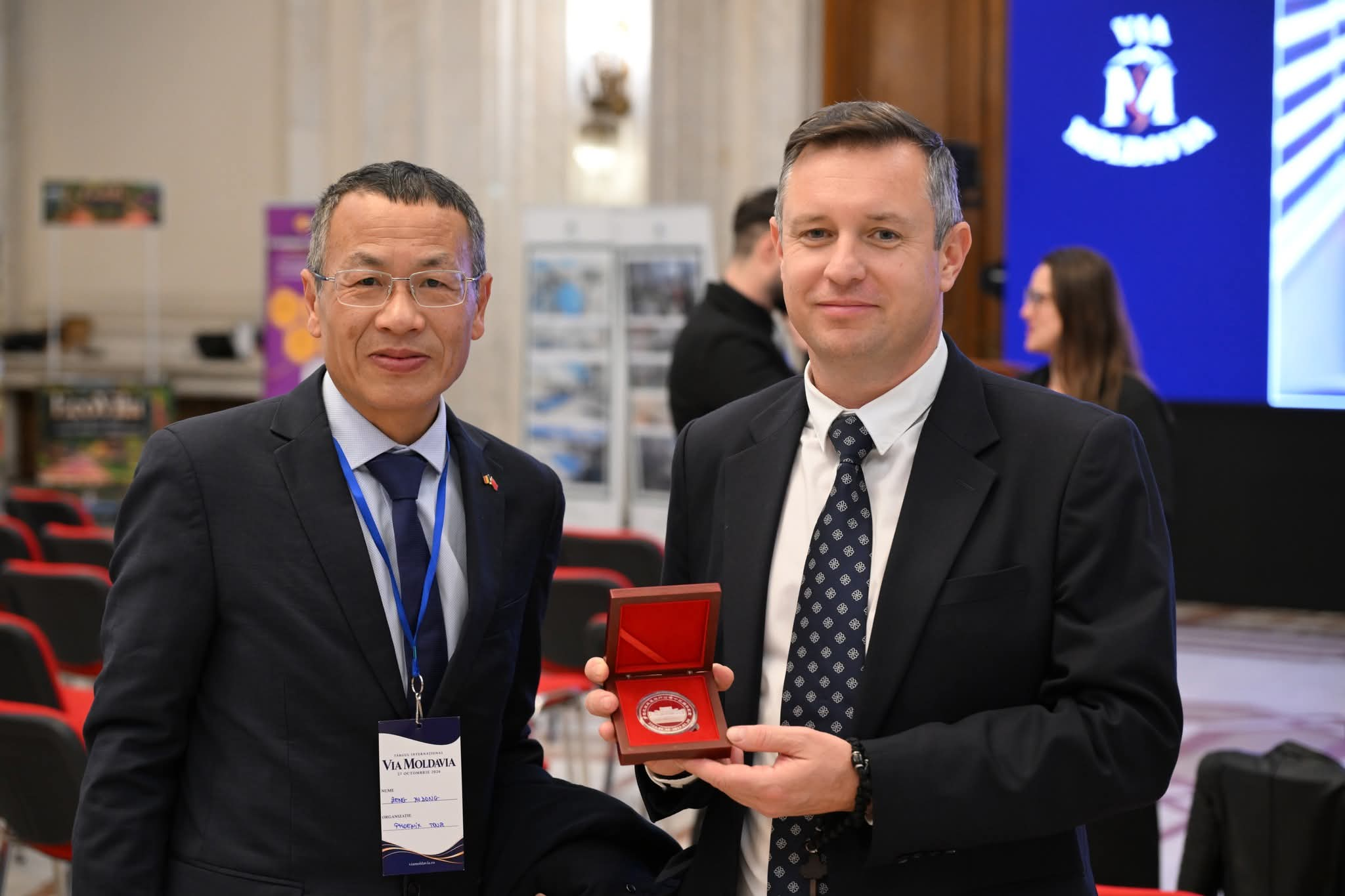
CAPDR organised the VIA MOLDAVIA Working Meeting dedicated to the The Monasteries Land micro-destination

Mesaje publice
The VIA MOLDAVIA – Northern Route programme continued, on 28 September 2026, its series of territorial meetings dedicated to the creation and development of tourist micro-destinations, through the meeting dedicated to The Monasteries Land
The meeting took place at Sucevița Town Hall, Suceava County, and aimed to develop an integrated tourism offer for a territory where monastic heritage represents a defining element of its identity and tourism appeal.
The indicative territorial area of the micro-destination includes Sucevița, Voroneț, Dragomirna, Putna and the surrounding monastic area, bringing together important landmarks for the development of cultural, religious and heritage tourism, as well as for the creation of tourism experiences that capitalize on nature, gastronomy, hospitality, local events and services.
The meeting sought to move beyond the perspective of simply listing attractions and to analyse how they can be connected into a coherent tourism experience, capable of encouraging visitors to discover the territory, extend their stay and integrate The Monasteries Land into the regional circuits of VIA MOLDAVIA – Northern Route.

EVENT PARTICIPANTS:
- Ion ȘTEFANOVICI – President, C.A.P.D.R.
- Bogdan LOGHIN – Mayor, Rădăuți Town Hall
- Ghoerghe LAZAR – Mayor, Marginea Town Hall
- Sergiu CHETRARU – Administrator, Sucevița / Tourist Stopover
- Petru MOȚAC – Ancor Guesthouse & Restaurant, Burla
- Dumitru MIHALESCUL – Marelvi
- Aurel OLAREAN – Administrator, Hotel Maria
- Dorel COTOS – Administrator, Nordic Twins
- Doinița DEREVLEAN – Administrator, Casa cu Cerbi
- Gabriela SCRIPCARU – Antique
- Alina SETIOC – Administrator / Manager, Ziva Restaurant / Electra Rădăuți
- Alina AGA – Administrator, Bucovina Putna Guesthouse & Restaurant
- Viorel PINTILIUC – Mayor, Burla Town Hall
- Costică GRĂILAN – Administrator, Casa Măriuca
- Alina HUROȘAN – Collaborator, Bucovina Conect
- Cristina HORȘA – Administrator, Broli
- Zaroando DOMINGO – Collaborator, Bucovina Conect
- Ceramica Marginea

Putna, Sucevița, Moldovița – a geography of Moldova’s spirituality and a major European tourism destination

Sucevița – the centre of a spiritual geography

Moldova – a living frontier of European Christianity
Putna, Sucevița and Moldovița still carry this memory of Christian Moldova to this day.

Putna – the memory of Moldova
Sucevița – frescoes and tranquillity

Moldovița – the continuity of a world
Romania and the Republic of Moldova – the same spiritual matrix

The Romanian Orthodox Church – partner in the micro-destination

A strong tourism economy already exists around the major monasteries.

Marginea – Bucovina’s living treasure


From route to destination
This is also the purpose of VIA MOLDAVIA.
- Monastery to monastery
- Village to village
- Craftsman to guesthouse
- Restaurant to local producer
- Community to community
- Spirituality
- Heritage
- Nature
- Gastronomy
- Craftsmanship
- Hospitality

The Monasteries Land – the spirituality of Moldova
- The Church provides the spiritual dimension
- Communities preserve authenticity
- Tourism operators create the experience
- Local administrations support infrastructure
- Craftspeople carry the memory forward
The Monasteries Land – the spirituality of Moldova transformed into a travel experience.

Mapping the micro-destination within a 20-kilometre radius
The central objective of the meeting was the actual mapping of the micro-destination, starting from a central point and a standard radius of 20 km.
The VIA MOLDAVIA methodology provides for the identification and geolocation of tourism resources, followed by verification of actual distances, travel times and accessibility.
For The Monasteries Land, this stage is important because it enables the identification of all resources that can complement the main heritage offer.
The map tracks tourist attractions, accommodation facilities, gastronomic points, events, experiences and services available in the territory.
Each resource can become a component of a more complex experience. A monastery can represent the central point of a day of sightseeing, while local gastronomy, a producer, an event or a cultural experience can complete the route and give tourists the opportunity to discover the community and territory in greater depth.
Therefore, mapping is not merely a technical exercise, but the foundation for building a coherent tourism story about The Monasteries Land.

Connecting The Monasteries Land to the Northern Route
The Monasteries Land is not being developed within VIA MOLDAVIA as an isolated destination.
One of the meeting’s key objectives was to identify connections with the other micro-destinations within the Northern Route, allowing tourists to continue their journey towards other territories.
The VIA MOLDAVIA methodology focuses on identifying entry and exit points, connections with neighbouring micro-destinations and possibilities for developing 2–7-day circuits between several territories.
Within this network, The Monasteries Land can represent both a destination in its own right and an important point within a broader circuit through northern Moldova and Bucovina.
By connecting with other micro-destinations, tourists can be offered the opportunity to build a diversified journey in which monastic heritage is complemented by nature, active tourism, gastronomy, local experiences and other forms of tourism.

From selection to tourism product
The micro-destination development process follows the methodological logic:
SELECT → VALIDATE → BUILD → TEST → SELL.
At this stage, relevant resources are selected, information is validated, routes and experiences are developed, analysed from the tourist’s perspective and prepared to become tourism products.
For each product, elements such as route, included services, capacity, period, indicative price, target audience and sales channel are considered.
In the case of The Monasteries Land, this process can enable the development of products combining monastic heritage with gastronomy, local experiences, nature, events and tourism services.
The ultimate objective is for tourists to find not merely information about an attraction, but a complete experience, with a route, services and options for continuing the journey.

From heritage to digital experience
The offer developed in the territory must also be accessible in the digital environment.
Within the VIA MOLDAVIA workflow, the information collected is prepared for the stages of proposal, profiling, validation, translation, publication and updating, and will subsequently be integrated into the back office and the application intended for tourists.
For The Monasteries Land, this component can contribute to the integrated presentation of heritage and local experiences, making it easier for tourists to discover routes, services and opportunities for spending their time.
In a tourism context where travel decisions are increasingly influenced by digital information, the visibility and accessibility of the offer become part of the experience itself.

Preparing The Monasteries Land for the tourism market
An important stage in the development of the micro-destination will be the VIA MOLDAVIA International Tourism Fair, scheduled for 26–28 October 2026, at the Palace of Parliament in Bucharest.
The territorial meeting represents the stage at which the offer is identified, developed and validated, while the fair will represent the stage at which selected products and experiences can be presented to the tourism market.
Representative products and packages, promotional materials and B2B meetings with travel agencies, operators and interested partners can be prepared.
The VIA MOLDAVIA methodology thus establishes a direct link between the work carried out in the territory and the stage of presentation and engagement with the market.
For The Monasteries Land, this stage can highlight local heritage and experiences in an integrated format, oriented towards tourists and professionals in the tourism industry.

What VIA MOLDAVIA is concretely building
Through the work process dedicated to The Monasteries Land, the objective is to create an operational map of the micro-destination, identify and geolocate resources, establish connections with other territories, configure routes and circuits, and develop the first tourism products.
At the same time, the information required for integration into the back office will be identified, together with the elements that need to be completed or updated so that the offer can be published and promoted.
The process will also contribute to preparing preliminary offers for the VIA MOLDAVIA International Tourism Fair and B2B meetings, as well as to establishing the responsibilities required to keep information up to date.
Through this sequence, local heritage and resources are gradually transformed into a structured, connected tourism offer prepared for the market.
VIA MOLDAVIA continues to build the Northern Route
The meeting dedicated to The Monasteries Land represents a new stage in the official calendar of VIA MOLDAVIA – Northern Route, with the process continuing through new micro-destinations.
On 2 October 2026, the programme will continue at Șaru Dornei Town Hall, with the meeting dedicated to the Dornelor Basin micro-destination, whose indicative area includes Șaru Dornei, Dorna Arini, Panaci, Dorna Candrenilor, Vatra Dornei and Poiana Stampei.
On 6 October 2026, VIA MOLDAVIA will arrive in Chișinău, at the Ministry of Economic Development and Digitalization, for the meeting dedicated to the Chișinău destination, Republic of Moldova, with the Republic of Moldova representing the territorial area.
On 9 October 2026, the calendar will continue with the meeting dedicated to the Botoșani Cultural – Memorial Houses and Cultural Heritage micro-destination, while the meetings dedicated to Iași – business tourism, city breaks and religious tourism and Red Lake will have their dates confirmed at a later stage.
Calendar of VIA MOLDAVIA – Northern Route meetings:

The first meeting in this series took place in Târgu Neamț on 1 September 2026, dedicated to the RN-02 – Târgu Neamț – Neamț Fortress, monasteries and the Bison Land micro-destination. The meeting focused on identifying tourism resources and developing an experience connecting heritage, spirituality, nature and local hospitality.
On 3 September 2026, the process continued in Bicaz, for micro-destination RN-01, with a focus on nature, landscape, leisure and local experiences. The territory analysed includes Bicaz, Bicazu-Ardelean, Bicaz-Chei, Tarcău, Ceahlău, Hangu, Grințieș and Durău. The meeting highlighted the need to connect resources and transform them into tourism experiences and products.
On 8 September 2026, at the Panoramic Complex in Slănic Moldova, CAPDR organised a new VIA MOLDAVIA working meeting dedicated to the Valea Trotușului Micro-destination – spa tourism, nature, heritage and leisure, as part of the process of identifying, connecting and capitalising on local tourism resources into integrated products and experiences.
Within the VIA MOLDAVIA programme, on 10 September 2026, CAPDR organised a working meeting in Gura Humorului dedicated to RN-07 – Ariniș and the Gura Humorului ski area Micro-destination, focusing on the identification and capitalisation of local tourism resources.
The VIA MOLDAVIA working meeting dedicated to the Talienilor Road Micro-destination, held on 21 September 2026 in Mălini, Suceava County, brought together representatives of public administration, the tourism, forestry and business sectors to develop an integrated tourism offer.
CAPDR organised the VIA MOLDAVIA working meeting dedicated to the Talienilor Road micro-destination
On 25 September 2026, the VIA MOLDAVIA meeting dedicated to the TransRarău Micro-destination and ski area took place in Vama.
On 2 October, the series will continue with RN-04 – Dornelor Basin, with the meeting hosted by Șaru Dornei Town Hall. The indicative area of this micro-destination includes Șaru Dornei, Dorna Arini, Panaci, Dorna Candrenilor, Vatra Dornei and Poiana Stampei.
On 6 October, the programme will have a stage dedicated to RN-14 – Chișinău, Republic of Moldova. The meeting is scheduled to take place at the Ministry of Economic Development and Digitalization in Chișinău and will have the Republic of Moldova as its indicative territorial area, strengthening the perspective of connecting the VIA MOLDAVIA network with the cross-border Romania–Republic of Moldova component.

On 9 October, the calendar provides for the meeting dedicated to RN-10 – Botoșani Cultural – Memorial Houses and Cultural Heritage. The date has been established, while the location is to be confirmed. The micro-destination will have the municipality of Botoșani and the surrounding territory as its indicative area.
As the calendar continues, the meeting dedicated to RN-11 – Iași – business tourism, city breaks and religious tourism will have a date confirmed at a later stage. The micro-destination will have the municipality of Iași and the surrounding territory as its indicative area.
Also with a date to be confirmed is the meeting dedicated to RN-15 – Red Lake, with the indicative territorial area of Red Lake / Harghita. This will complete the series of micro-destinations included in the VIA MOLDAVIA calendar.

The Monasteries Land – heritage connected through a regional tourism experience
Through the Sucevița meeting, the VIA MOLDAVIA programme continued the process of building a tourism network in which local heritage is connected to experiences, services, routes and territories.
The Monasteries Land has a strong tourism core defined by its monastic and cultural heritage. However, its development as a micro-destination requires this heritage to be connected with all the other elements capable of transforming a visit into a memorable experience: hospitality, gastronomy, nature, events, guiding, services and routes.
By connecting Sucevița, Voroneț, Dragomirna, Putna and the surrounding monastic area, VIA MOLDAVIA aims to develop a destination that can be discovered at different paces and integrated into broader tourism circuits.
Within this approach, The Monasteries Land is not merely a heritage area, but becomes part of a regional tourism network in which each micro-destination contributes to a broader experience of northern Moldova and Bucovina.
And the principle guiding the entire VIA MOLDAVIA process remains:
The micro-destination builds the local offer. The Route connects it regionally. The network validates it. The application personalises it for the tourist. The market transforms it into a commercial product.
For The Monasteries Land, this development means transforming heritage and local resources into an integrated tourism offer capable of attracting visitors, encouraging them to discover more of the territory and connecting their experience with the other destinations of VIA MOLDAVIA – Northern Route.